Every Passive House uses an energy balance model. The model uses an Excel spreadsheet with upwards of 40 sheets. The model has grown and changed over the last twenty five years, and has taken on an iconic name: PHPP (Passive House Planning Package). It has incorporated more features, included additional data sets, and updated local regional weather patterns. This energy balance model accounts for the shade of neighbouring trees as well as every building that casts a shadow on any window when the sun is anywhere in the sky on any day of the year. But nonetheless, how accurate are the model’s results? How do we know that Passive House works?
The History
Passive House started in Germany in the 1990s. Later, the first study to compare actual energy usage to usage predicted by the PHPP also occurred in Germany. 106 dwellings in three cities were examined: Wiesbaden, Hannover, and Stuttgart. PH designers modeled these houses in PHPP and built them to the Passive House standard.
The Passive House standard calculates annual heating demand, which is express in kilo-Watt hours of energy is used per year divided by the living area in square meters. The units for this expression is kWh/m2a. The value of the threshold for this standard is 15 kWh/m2a. Every house built to the Passive House standard must show, in the PHPP model, that the predicted energy consumption is 15 kWh/m2a or less.
The Analysis
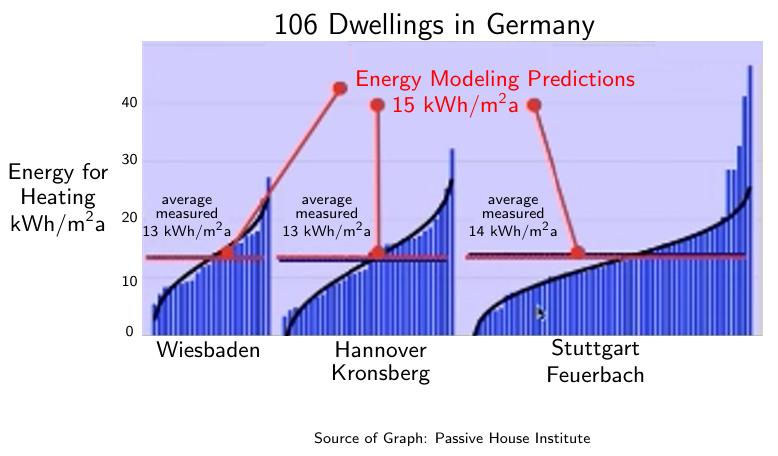
Researchers examined the energy consumption records of these 106 houses. Analysts use these records to calculate the annual heating demand for each structure. The results of these calculations are grouped by city, with the lowest annual heating demand on the left and houses with the next higher value immediately to the right. The annual heating demand for the houses in Wiesbaden range from 5 kWh/m2a to about 28 kWh/m2a. For Hannover the range is about 3 kWh/m2a to 32 kWh/m2a, and Stuttgart ranges from 3 kWh/m2a to 46 kWh/m2a.
Analysts calculate the city-wide average value from the energy values of homes within the city, and compare the average to the threshold value of 15 kWh/m2a. The average annual heating demand in Wiesbaden and Hannover is 13 kWh/m2a, and 14 kWh/m2a for Stuttgart. The PHPP energy balance model does a very good job of predicting the average annual heating demand for each German city. By the data from these three cities in Germany, we can we that Passive House Works.
But why is there such variation in the actual annual heating demands for each individual dwelling. Well, each house is occupied by human. People have different preferences. The model uses an indoor winter temperature of 20C. Some people like their living space to be warmer. Others like it to be cooler. Some like to open windows in the Central European winter, and others don’t.
Despite the variation in actual energy usage, Passive House’s PHPP energy model makes very good predictions of annual energy usage on average.