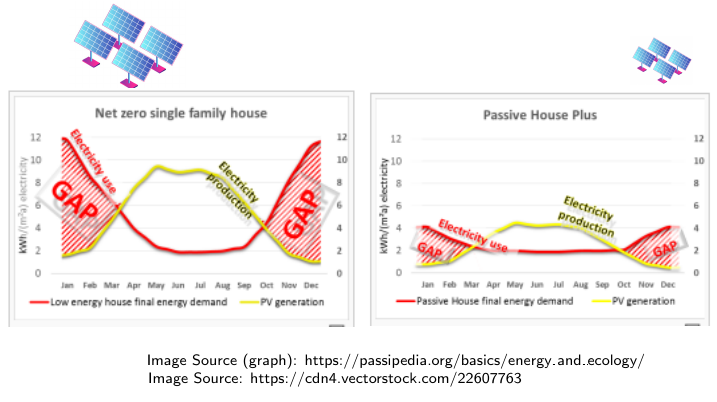
Passive House is not the only energy efficient building standard. LEED, R-2000, and Net-Zero are some of the other popular building standards. Net Zero is popular because you will produce as much energy during the year as you consume. Seems reasonable, but let’s make a Net-zero comparison.
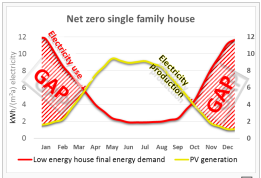
The graph to the right is a sample “annual energy demand” graph for a Net Zero house. The yellow line is production, more in the summer for photovoltaics generating electricity. The red line is consumption, more in the winter. During some months, energy flows to the grid. Other months, you pull energy from the grid. During the course of the year, you produce as much energy as you consume.
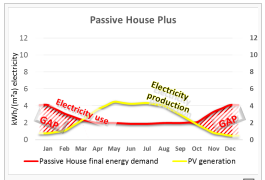
The graph to the left is a sample “annual energy demand” for a Passive House. You consume less energy. You’ll need to produce less energy. You need fewer solar panels and a smaller battery pack. So, you save money up front.
When built to the Passive House standard, you spend less money up front on Photovoltaic panels and all of the necessary equipment to properly size your new PV system.
This lower upfront costs when meeting the Passive House standard make it a perfect fit for SSMUH projects.
A Net-Zero comparison against Passive House proves that less upfront front capital is required. A structure built to the Passive House standard stays a comfortable temperature longer during a neighbourhood wide power outage. Building to the Passive House standard proves upfront cost savings.